Keywords
training
GEARS cirugía robótica
entrenamiento
GEARS
How to Cite
Abstract
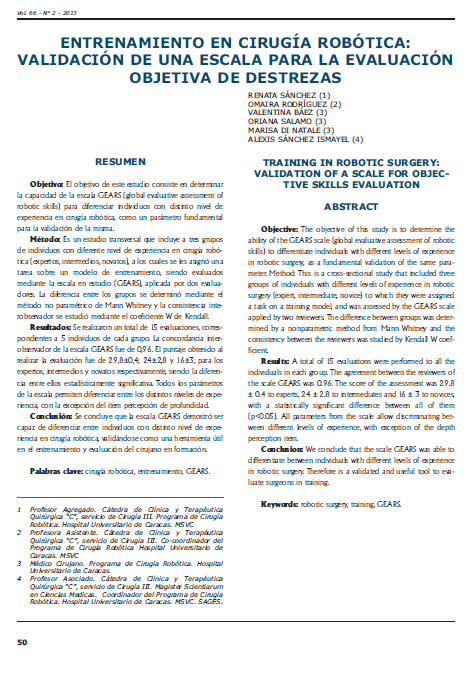
Objective: The objective of this study is to determine the ability of the GEARS scale (global evaluative assessment of robotic skills) to differentiate individuals with different levels of experience in robotic surgery, as a fundamental validation of the same parameter. Method: This is a cross-sectional study that included three groups of individuals with different levels of experience in robotic surgery (expert, intermediate, novice) to which they were assigned a task on a training model, and was assessed by the GEARS scale applied by two reviewers. The difference between groups was determined by a nonparametric method from Mann Whitney and the consistency between the reviewers was studied by Kendall W coefficient. Results: A total of 15 evaluations were performed to all the individuals in each group. The agreement between the reviewers of the scale GEARS was 0.96. The score of the assessment was 29.8 ± 0.4 to experts, 24 ± 2.8 to intermediates and 16 ± 3 to novices, with a statistically significant difference between all of them (p<0.05). All parameters from the scale allow discriminating between different levels of experience, with exception of the depth perception item. Conclusion: We conclude that the scale GEARS was able to differentiate between individuals with different levels of experience in robotic surgery. Therefore is a validated and useful tool to evaluate surgeons in training.

This work is licensed under a Creative Commons Attribution-NonCommercial 4.0 International License.
Copyright (c) 2020 REVISTA VENEZOLANA DE CIRUGÍA